This Historic 2.5-Mile Trail Near Scott Lake, Kansas, Is Worth the Scramble
Kansas is full of geological and military history; this hiking trail offers an epic combination of both.
Despite what many passers-by imply, Kansas is not a fly-over state. Instead, it begs to be driven, offering lesser-known attractions at every corner. It’s a road-trip state, daring the truly intrepid to chase its puzzling topography and riveting tales of war and triumph.
I personally can not get enough of Kansas. Every time I go back, I visit yet another place I can’t believe few people seem to know about. Here, I even fell in love with historical travel, which I never thought could be interesting to me, until I discovered its intriguing ways on this Kansas hiking trail. The site of the Battle of Punished Woman Fork is one of those places, and I’m eager to share its story.
Literally hidden in plain sight, the monument for the Battle of Punished Woman Fork is located just one mile south of Lake Scott State Park in west central Kansas. Some locals refer to it as Battle Canyon, but many people drive right past it, unaware of its existence or significance as a National Historic Site.
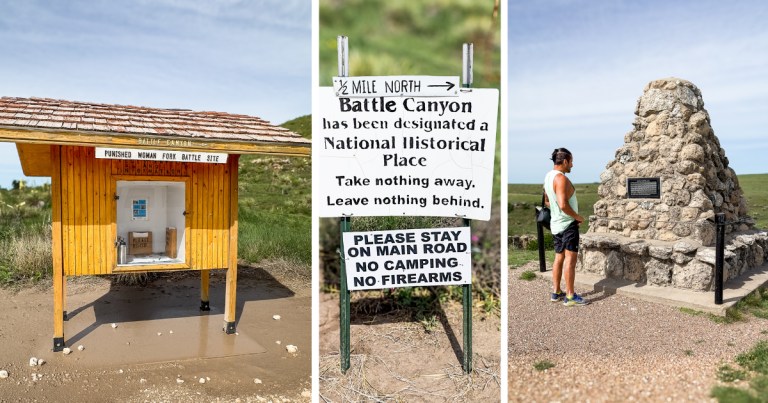
To get there, you’ll want to drive from Highway 83 to 95, as if you are entering the south side of Scott Lake State Park. Instead of going all the way to the lake, you’ll go west on a rough road at an intersection labeled Devil’s Backbone on Google Maps. Just as it sounds, the road climbs to the top of an unexpected ridge, snaking through undulating pastures.
At the top is an unassuming triangular-shaped stone monument with a plaque that reads “Battle Canyon, 1878.” Beyond the memorial, the natural wonder unfolds into an unexpected canyon, bluffs, and a cave below. Although no official hiking trail is listed or recommended, an obvious dirt path connects the monument to the cave and then into the canyon, looping back up and returning to the top. The unnamed trail is an estimated 2.5-mile loop that allows us to walk in the footsteps of the U.S. Cavalry and several hundred members of the North Cheyenne tribe, who fought a devastating battle here during the American Indian Wars.

The cave, known as Sanctuary Cave, harbored the Northern Cheyenne women, children, and elders and is credited with saving their lives while countless warriors and soldiers above them perished. Under the cloak of darkness, the remaining Northern Cheyenne escaped to freedom. The Battle of Punished Woman Fork was the last recorded violent interaction between the U.S. Military and the Native Americans in Kansas.
Despite knowing what took place here, the remote landscape exhibits a deafening silence, an irrefutable eeriness, and a surprising prairie oasis. With no buildings in sight, it’s possible to imagine precisely what took place here nearly 150 years ago. Yet beyond its historical relevance, The Battle of Punished Woman Fork also exhibits a natural environment that seems untouched and unchanged by time. You can see numerous native grasses, flowers, birds, animals, and reptiles thriving in the canyon on this Kansas hiking trail.

Due to its remoteness and lack of infrastructure, hiking to the site of the Battle of Punished Woman Fork should be done with extreme caution. The trails above, around, and through the canyon can be slippery and steep, with routine sightings of venomous rattlesnakes. Before you enter the park, please register at the road entrance, carefully listing the time you entered and all members of your group.
Thinking of a Kansas road trip? Try Only In Your State's AI-powered itinerary planner.
Subscribe to our newsletter
Get the latest updates and news
Thank you for subscribing!